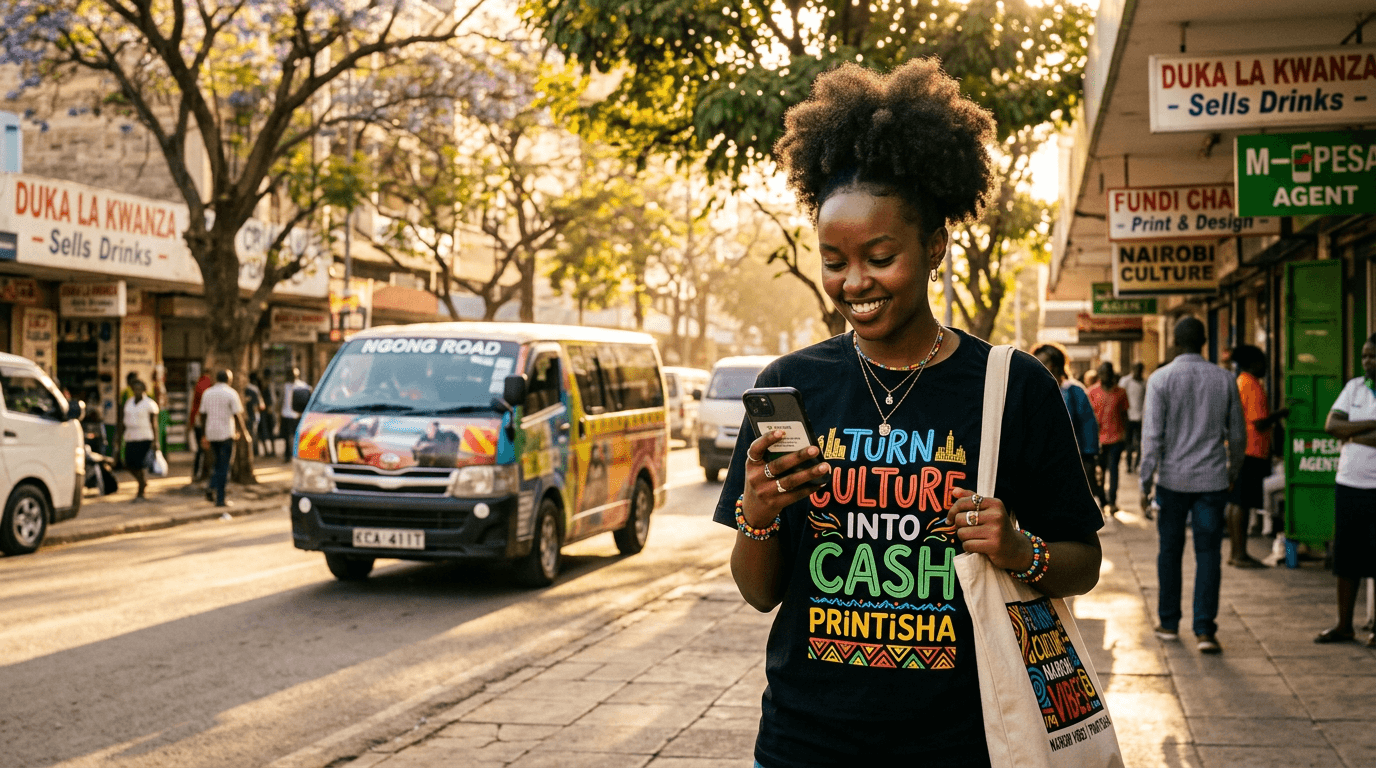
If you've ever tried to use Printful, Redbubble, or Teespring from Kenya, you know the wall. You hit it the moment you try to set up payments. Or check shipping rates. Or see "$24.99" on a t-shirt that would sell for KES 1,500 locally.
Global print-on-demand platforms are amazing — if you're in the US or Europe. For Africa, they're fundamentally broken. Not because the technology is bad, but because they weren't built for this market.
Here's why, and what the alternative looks like.
5 Reasons Global POD Doesn't Work in Africa
1. No M-PESA (or Any Local Payment Method)
This is the dealbreaker. In Kenya, over 90% of digital transactions go through M-PESA. Not credit cards. Not PayPal. M-PESA.
Printful, Redbubble, and Teespring only accept credit/debit cards or PayPal for customer payments. That immediately excludes the vast majority of your potential Kenyan customers. Even if someone has a card, the friction of entering card details vs. an M-PESA STK push is the difference between a sale and an abandoned cart.
For creator payouts, it's even worse. These platforms pay via Stripe, PayPal, or bank wire. Getting USD out of Stripe into a Kenyan bank account involves conversion fees, delays, and sometimes outright blocks. Forget getting it to M-PESA directly.
2. Shipping Costs That Kill the Sale
Global POD platforms print in the US, EU, or Asia. Shipping a single t-shirt from the US to Kenya costs $15–$30 (KES 2,000–4,000). That's often more than the shirt itself.
No Kenyan customer is paying KES 4,000 for shipping on a KES 1,500 t-shirt. The economics simply don't work for selling to a local audience.
"But what about selling to international customers?" — Sure, if your audience is global. But most Kenyan creators have a primarily Kenyan audience. You need to sell where your fans are.
3. Delivery Takes Weeks (If It Arrives at All)
Even if a customer is willing to pay for international shipping, delivery to Kenya takes 2–6 weeks. Customs clearance adds uncertainty and sometimes extra fees. Tracking is unreliable. And returns? Practically impossible.
Compare that to local delivery in 2–4 business days within Nairobi and 4–7 days upcountry. The customer experience difference is night and day.
4. USD Pricing Doesn't Work
Global platforms price everything in USD. A "cheap" t-shirt at $19.99 is KES 2,600. That's premium pricing in Kenya. The average Kenyan customer expects to pay KES 1,200–2,000 for a quality printed t-shirt. The currency mismatch makes global platforms uncompetitive in the local market.
Plus, exchange rate fluctuations mean your pricing is never stable. What costs KES 2,500 today might cost KES 2,800 next month — and you have no control over it.
5. Creator Payouts Are a Nightmare
Let's say you do manage to sell on Redbubble or Teespring. How do you get paid?
- Redbubble: PayPal or bank deposit. Minimum $20 payout. PayPal charges conversion fees. Bank deposits take 5–15 business days and may require a USD account.
- Teespring (Spring): PayPal only. Same conversion issues.
- Printful + Shopify: Stripe payouts. Stripe in Kenya is limited. Even when it works, you lose 3–5% on conversion.
Meanwhile, your rent, food, and matatu fare are in KES. You need money in M-PESA, not stuck in a PayPal account with withdrawal fees.
What Makes the African Market Different
The African market isn't just the US market with different currencies. It has fundamentally different dynamics:
- Mobile-first everything. Over 80% of internet access in Kenya is via smartphone. Your store, checkout, and payment flow must be mobile-native. M-PESA is already on every phone — that's the checkout UX to match.
- Price sensitivity is real. The average Kenyan income is lower than the US. A $25 t-shirt is a luxury purchase here. Pricing must reflect local purchasing power, not US margins.
- Trust is earned differently. In the US, people trust a Shopify checkout. In Kenya, people trust M-PESA. They trust seeing a local phone number. They trust delivery timelines they can verify.
- Social commerce is king. Kenyan creators sell through Twitter threads, Instagram DMs, and WhatsApp groups. The platform needs to work with these channels, not against them.
- The creator economy is exploding. Kenya has a massive, young, creative population. Twitter KE, Kenyan TikTok, and Kenyan YouTube are producing world-class content. These creators deserve tools built for them.
Printisha vs Global POD: Side-by-Side
| Feature | Printful / Redbubble | Printisha |
|---|---|---|
| Customer payments | Credit card, PayPal | M-PESA (STK Push) |
| Creator payouts | Stripe, PayPal, bank wire | Direct to M-PESA |
| Currency | USD / EUR | KES |
| Printing location | US, EU, Asia | Nairobi, Kenya |
| Delivery (to Nairobi) | 2–6 weeks, KES 2,000–4,000 | 2–4 days, KES 200–400 |
| Delivery (upcountry) | 4–8 weeks, KES 3,000–6,000 | 4–7 days, KES 300–800 |
| T-shirt retail price | KES 2,500–4,000+ (with shipping) | KES 1,200–2,500 (creator sets price) |
| Design tool | Basic mockup generator | Full canvas editor + element library |
| Store page | Generic marketplace listing | Custom branded creator store |
| Support | Email (US timezone) | WhatsApp + email (EAT timezone) |
Who Printisha Is For
Printisha is built for anyone in Kenya who wants to sell custom merchandise without the traditional headaches:
- Social media creators who want to turn their following into merch income. Twitter personalities, Instagram artists, TikTok creators, YouTubers — if you have an audience, you can sell merch.
- Artists and designers who want to sell their art on physical products without dealing with printers and delivery.
- Musicians and DJs who want branded merch for fans without upfront investment. Drop a merch line with every album, EP, or event.
- Event organisers who need custom merchandise for conferences, workshops, or community events without bulk-ordering headaches.
- Merch brokers who connect organisations with custom products. Use Printisha as your fulfilment backend and keep the profit margin.
The State of POD in Africa (2026)
Print-on-demand is a $10 billion+ global industry — but almost none of that is in Africa. Not because the demand isn't there, but because no one has built the infrastructure for it.
Kenya has 30+ million internet users, a booming creator economy, and M-PESA — the most advanced mobile money system in the world. The audience is ready. The payment rails exist. The creators are here. What was missing was a platform that puts it all together.
Printisha is that platform. Local printing in Nairobi. M-PESA in and M-PESA out. KES pricing. Built-in design tools. Creator stores. And delivery that actually reaches your customers in days, not weeks.
We're starting with Kenya, but the vision is pan-African. The same mobile-money-first, local-printing, local-delivery model can work in Nigeria (with Flutterwave), South Africa (with SnapScan), and across East Africa. Africa's creator economy deserves infrastructure built for it.
Frequently Asked Questions
Can I use Printful/Redbubble to sell to international customers from Kenya?
Technically, yes. If your audience is primarily in the US or Europe, global platforms can work — your customers will have cards and reasonable shipping rates. But you'll still deal with payout issues getting money to Kenya. If your audience is in Kenya or Africa, use Printisha instead.
Is Printisha only for Kenya?
We're starting with Kenya because it's where we can deliver the best experience — local printing, M-PESA integration, and fast delivery. We plan to expand to other African markets as we grow. If you're in another East African country, join the waitlist and we'll notify you when we launch in your market.
What about quality? Is local printing as good as Printful?
We use DTF (Direct-to-Film) and DTG (Direct-to-Garment) printing technology — the same technologies used by Printful. The blanks are quality, the prints are vibrant, and they're built to last. We quality-check every order before shipping.
How much does it cost to start?
KES 0. Creating a store, designing products, and listing them is completely free. You only pay (from your sales, not your pocket) when a customer orders. Read our complete guide to selling merch in Kenya for the full cost breakdown.
Can I sell on my own website instead of Printisha?
Right now, your products live on your Printisha creator store. We're working on API integrations that will let you embed products on your own website or Shopify store in the future. For now, your Printisha store link is the simplest way to sell — just share it and customers can browse and buy.
Ready to Start?
Global POD platforms weren't built for Africa. Printisha was. If you're a Kenyan creator ready to sell merch without the headaches of traditional methods or the impossibility of global platforms, we built this for you.
Already know about merch? Read our complete guide to selling merch in Kenya or learn about 7 ways to make money from social media in Kenya.
About the author: Victor is the founder of Printisha, Kenya's first creator drop platform. He built Printisha because he was tired of seeing Kenyan creators locked out of the global merch economy by platforms that weren't designed for this market.