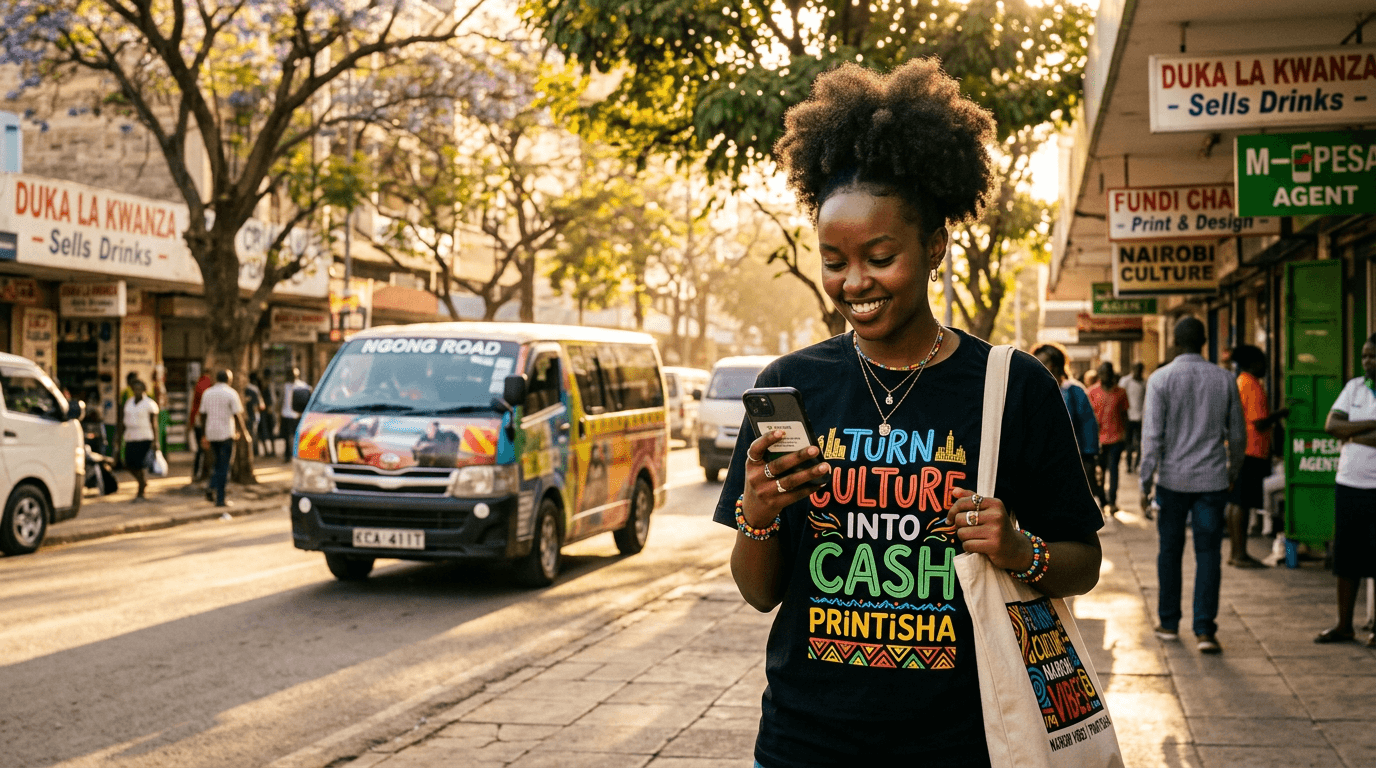
I've spent 2 years selling merch in Kenya. Custom t-shirts, hoodies, caps, tote bags — you name it. I've coordinated orders on WhatsApp, haggled with screen printers in Industrial Area, and personally delivered packages across Nairobi in matatus. I know what works, what doesn't, and what nobody tells you.
This is the guide I wish I had when I started. No fluff, no "just believe in yourself" nonsense. Real costs, real margins, and a step-by-step path from zero to selling merch with M-PESA payouts.
What Selling Merch Actually Looks Like in Kenya
Let's be honest about what "selling merch" means in Kenya. It's not like the US where you upload a design to Shopify and wait for orders. In Kenya, selling merch is a full-contact sport.
You're the designer, the marketer, the customer service rep, the delivery person, and the accountant — all at once. Most people start by selling to their own followers on Twitter (X), Instagram, or TikTok. Some sell at events. Some broker bulk orders for schools or churches.
But the pattern is always the same: you find customers, collect money, coordinate printing, and handle delivery. The question is whether you do it the hard way or the smart way.
The Typical Kenya Merch Hustle (7 Steps)
Here's what the traditional merch process looks like. If you've done this, you'll recognise every step:
- Step 1: Design something. You use Canva, Photoshop, or pay a designer KES 2,000–5,000.
- Step 2: Post it on socials. "New merch dropping! DM to order."
- Step 3: Wait for DMs. People ask "How much?" — even though you posted the price. You reply to each one individually.
- Step 4: Collect sizes and payments. Screenshots of M-PESA confirmations flooding your WhatsApp. You track orders in a notebook or a Google Sheet (if you're fancy).
- Step 5: Wait for enough orders. The printer needs a minimum of 20–50 pieces. So you wait. And wait. And lose momentum.
- Step 6: Coordinate printing. You go to the printer, negotiate price, wait 3–7 days, pray the quality is decent, then go back to collect.
- Step 7: Deliver. Some people pick up. Some want delivery. You spend 2 days crisscrossing Nairobi. Some people ghost you. Your margins evaporate.
Sound familiar? That's because this is how 95% of merch sellers in Kenya operate. It works — technically. But it doesn't scale, and it eats your time alive.
The Real Costs Nobody Talks About
Before you start, you need to know the real numbers. Not the "passive income!" fantasy — the actual costs:
| Item | Cost (KES) | Notes |
|---|---|---|
| Blank t-shirt (Gildan equivalent) | 350–600 | Depends on quality, colour, supplier |
| Screen printing (1 colour) | 150–300 | Per piece, cheaper in bulk (50+) |
| DTF/DTG printing (full colour) | 250–500 | Per piece, better for detailed designs |
| Design (if hiring) | 2,000–5,000 | One-time per design |
| Packaging | 30–100 | Polybag to branded box |
| Delivery (within Nairobi) | 200–400 | Per order, rider or matatu |
| Delivery (upcountry) | 300–800 | Bus parcel or courier |
| Total cost per t-shirt | 780–1,900 | Before your profit |
If you sell a t-shirt for KES 1,500 and your total cost is KES 900, your profit is KES 600. That's decent — until you factor in the hours spent coordinating, the orders that fall through, and the customers who ghost after saying "I'll send later."
Why the Old Way Is Broken
Five reasons the traditional merch hustle hits a wall:
- 1. Minimum order quantities. Printers want 20–50 pieces minimum. If you only get 12 orders, you either eat the extra cost or lose momentum waiting for more.
- 2. Upfront capital. You need KES 15,000–50,000 before you sell a single shirt. That's money most creators don't have.
- 3. Inventory risk. You print 50 tees and sell 30. Now you have 20 shirts in your wardrobe collecting dust. Wrong sizes? Tough luck.
- 4. Time drain. Every order is a manual process. DMs, M-PESA screenshots, size confirmations, delivery scheduling. It's a full-time job that pays part-time wages.
- 5. No storefront. You don't have a website. Your "store" is a WhatsApp status and a Twitter thread. Customers can't browse, compare, or self-serve.
Enter Print-on-Demand
Print-on-demand (POD) flips the model. Instead of printing in bulk and hoping you sell, each item is printed only after a customer orders it. No minimum quantities. No upfront cost. No leftover inventory.
Global platforms like Printful and Redbubble have made this model huge in the US and Europe. But they don't work in Kenya — no M-PESA, no local delivery, USD pricing, and creator payouts via Stripe (which barely works here). Read more about why global POD platforms fail in Africa.
That's why we built Printisha — the creator-drop platform built specifically for Kenya. M-PESA payments in, M-PESA payouts out. Local printing, local delivery. Prices in KES. No middleman currency conversion eating your margins.
How to Start Selling Merch With Printisha (5 Steps)
Here's how the new way works, step by step:
- Step 1: Sign up as a creator. Get an invite code and launch your first drop. Pick your store name, add your bio and profile photo. Takes 5 minutes.
- Step 2: Design your merch. Use our built-in design tool to create your artwork. Upload your own designs or use our element library. Place your design on the product mockup in real time. No Photoshop needed.
- Step 3: Set your price. We show you the base cost (what printing + materials cost us). You set whatever selling price you want above that. The difference is your profit — 100% yours. Want to sell a tee for KES 2,000 when the base cost is KES 800? That's KES 1,200 profit. Your choice.
- Step 4: Share your store link. You get a store page with all your products. Share the link on Twitter, Instagram, TikTok, WhatsApp — wherever your audience is. Customers browse, pick sizes/colours, and pay via M-PESA. No DMs needed.
- Step 5: We handle the rest. When someone orders, we print it, pack it, and ship it. You get paid your profit directly to M-PESA. Track everything from your creator dashboard.
That's it. No upfront cost. No inventory. No delivery headaches. You focus on creating and promoting — we handle the rest.
The Math: What Can You Actually Earn?
Let's look at three real scenarios based on different follower counts and engagement levels:
Scenario 1: Amani — 2,000 Followers
Amani is a Nairobi-based illustrator with 2,000 followers on Instagram. She posts her artwork regularly and has an engaged audience that loves her style.
- She designs 3 t-shirts with her best illustrations
- She prices each at KES 1,800 (base cost: KES 800, profit: KES 1,000 per tee)
- With 2% conversion rate, she sells about 10 tees in the first month
- Monthly profit: KES 10,000
- She adds hoodies (profit: KES 1,500 each) and sells 5 more
- Revised monthly profit: KES 17,500
Not life-changing, but that's KES 17,500/month for work she already does (making art) — with zero delivery headaches.
Scenario 2: DJ Mwangi — 8,000 Followers
DJ Mwangi has 8,000 followers on Twitter and plays gigs around Nairobi. His audience is loyal and loves repping his brand.
- He designs 5 products: 3 tees, 1 hoodie, 1 cap
- Average profit per item: KES 1,000
- With 3% conversion rate (higher because his fans are loyal), he sells 60 items in the first month
- Monthly profit: KES 60,000
- He drops a new limited design each month to maintain hype
- He mentions his merch at gigs: "Link in bio"
KES 60,000/month from merch alone. That's a solid side income on top of his DJ earnings.
Scenario 3: Otieno the Broker — Bulk Orders
Otieno doesn't have a big following. He's a merch broker — he connects schools, churches, companies, and events with custom merch. He uses Printisha as his backend.
- A church orders 100 choir t-shirts. Base cost: KES 700/ea. He prices at KES 1,200/ea.
- Profit per order: KES 50,000
- A school orders 200 leavers' hoodies. Base cost: KES 1,200/ea. He prices at KES 2,000/ea.
- Profit per order: KES 160,000
- He does 2–3 bulk orders per month
- Monthly profit: KES 100,000–300,000+
Otieno never touches a t-shirt. He designs (or has someone design), sets prices, shares the order link, and collects his profit to M-PESA.
Old Way vs Printisha: Side-by-Side
| Factor | Traditional Way | Printisha |
|---|---|---|
| Upfront cost | KES 15,000–50,000 | KES 0 |
| Minimum order | 20–50 pieces | 1 piece |
| Inventory risk | You buy unsold stock | Zero — print on demand |
| Delivery | You coordinate | We handle it |
| Payments | Manual M-PESA screenshots | Automatic M-PESA checkout |
| Payouts | You keep what's left | Automatic to M-PESA |
| Storefront | WhatsApp/Twitter thread | Professional online store |
| Time per order | 30–60 min | 0 min (automated) |
Tips for Selling More Merch
Having a store is step one. Selling consistently is the real game. Here are six tips from my own experience:
- 1. Wear your own merch. Post photos and videos wearing it. If you don't rock your own stuff, why would anyone else?
- 2. Create scarcity. Limited drops work. "Only 50 available" creates urgency that "always available" never will.
- 3. Use your content. If you're a creator, tie your merch to your content. A catchphrase, a meme, an inside joke — those sell better than generic designs.
- 4. Pin your store link. Pin it on your Twitter profile, put it in your Instagram bio, add it to your WhatsApp status. Make it impossible to miss.
- 5. Launch with a story. Don't just post "new merch." Tell the story behind the design. Why you made it, what it means, who it's for.
- 6. Engage buyers. Repost customers wearing your merch. Thank them publicly. Build a community around your brand, not just a transaction.
Frequently Asked Questions
How much does it cost to start?
KES 0. Signing up, designing, and listing products on Printisha is completely free. You only "spend" when a customer buys (and the base cost is deducted from the sale, not from your pocket).
How do I get paid?
Your profit is sent directly to your M-PESA after each order is fulfilled. No invoicing, no bank transfers, no waiting 30 days.
Can I sell if I don't know how to design?
Yes. Our design tool has an element library with ready-made graphics you can use. You can also upload designs from Canva or hire a designer — you just need a PNG or SVG file.
What products can I sell?
Currently: t-shirts, hoodies, caps, and tote bags. We're adding mugs, phone cases, and posters soon.
Do you deliver outside Nairobi?
Yes. We deliver across Kenya. Nairobi deliveries take 2–4 business days. Upcountry deliveries take 4–7 business days via partner couriers.
How is this different from ordering from a printer myself?
You don't need upfront capital, you don't handle inventory, you don't coordinate delivery, and you get a professional online store with M-PESA checkout. You focus on creating and marketing — we handle operations.
Is there a catch?
No catch. We make money from the base cost margin (the cost of printing, materials, and logistics). Your profit margin is entirely yours. We win when you sell more, so our incentives are aligned.
The Bottom Line
Selling merch in Kenya has always been possible — but it's been unnecessarily hard. The DM chaos, the printer negotiations, the delivery runs, the unsold inventory — none of that is "building a brand." It's just logistics.
Print-on-demand removes the logistics so you can focus on what actually matters: your creativity and your audience.
If you have an audience — even a small one — you can turn that following into income. And with Printisha, you can do it without spending a single shilling upfront.
Launch your first drop today →
About the author: Victor is the founder of Printisha, Kenya's first creator drop platform. Former merch broker, current recovering WhatsApp-coordinator. He built Printisha because he was tired of spending more time on logistics than on creativity.